

In today’s fast-paced digital world, website performance is paramount. Slow loading times can lead to high bounce rates, lost conversions, and a negative impact on your brand. Cloud hosting offers a powerful solution to these challenges, providing the scalability, reliability, and speed necessary to deliver a seamless user experience. This article will explore how cloud hosting improves website performance, examining the key benefits and advantages it offers over traditional hosting methods. Understanding the impact of cloud hosting can be the key to unlocking your website’s full potential and achieving online success.
From improved page load speeds and enhanced security to increased scalability and reduced downtime, the advantages of cloud hosting are numerous. Whether you’re running a small blog, an e-commerce store, or a large enterprise website, leveraging the power of the cloud can significantly improve your website’s performance and contribute to a more positive user experience. This article will delve into the specifics of how cloud hosting delivers these benefits, empowering you to make informed decisions about your website’s infrastructure and optimize its performance for maximum impact.
What Makes Cloud Hosting Fast?
Cloud hosting leverages the power of distributed resources to achieve superior speed. Instead of relying on a single server, your website taps into a network of interconnected servers. This distributed architecture allows for high availability and redundancy, ensuring your website stays online even if one server fails.
Resource scalability is another key factor. Cloud hosting dynamically allocates resources like RAM and processing power based on real-time demand. This means your website can handle traffic spikes efficiently, preventing slowdowns during peak periods. Content Delivery Networks (CDNs), often integrated with cloud platforms, further enhance speed by caching website content closer to users geographically.
Load Balancing and Auto-Scaling
Load balancing and auto-scaling are crucial aspects of cloud hosting that significantly enhance website performance and availability. Load balancing efficiently distributes incoming traffic across multiple servers. This prevents any single server from being overwhelmed, ensuring faster response times and a smoother user experience, even during traffic spikes.
Auto-scaling complements load balancing by dynamically adjusting the number of active servers based on real-time traffic demands. When traffic increases, the system automatically adds more servers to handle the load. Conversely, during periods of low traffic, it reduces the number of servers to optimize resource utilization and cost-efficiency.
Content Delivery Networks (CDN)
A Content Delivery Network (CDN) is a geographically distributed network of servers that work together to provide fast delivery of Internet content.
CDNs store cached copies of your website’s static assets, like images, CSS, and JavaScript files, on servers located closer to your users. When a user requests your website, the CDN redirects the request to the server closest to them, reducing latency and improving page load times.
This distributed approach minimizes the distance data has to travel, resulting in a faster and more reliable user experience, regardless of their location.
Improved Uptime with Redundancy

Redundancy is a key feature of cloud hosting that significantly contributes to improved uptime. Cloud providers replicate your website’s data and resources across multiple servers and data centers. This means that if one server fails, another immediately takes over, ensuring your website remains online.
This failover process happens automatically and quickly, minimizing downtime. Traditional hosting relies on a single server, making it vulnerable to outages. With cloud hosting’s redundant infrastructure, the risk of extended downtime is drastically reduced.
Database Optimization Techniques
Database optimization plays a crucial role in enhancing website performance, especially in a cloud hosting environment. Efficient database queries reduce server load and improve response times.
Key techniques include query optimization, which involves analyzing and rewriting queries for faster execution. Indexing is also vital, as it allows the database to quickly locate specific data, reducing search time. Proper data type selection ensures efficient storage and retrieval.
Caching frequently accessed data can significantly reduce database load. Cloud platforms offer various caching mechanisms to leverage.
Global Server Distribution
A key advantage of cloud hosting is its global server distribution. By utilizing a network of servers located across the world, cloud hosting providers can offer reduced latency and improved website performance for users regardless of their geographic location.
When a user requests access to a website hosted on a cloud platform, the request is routed to the server closest to them geographically. This proximity minimizes the distance data needs to travel, resulting in faster loading times and a more responsive user experience.
Furthermore, global server distribution provides redundancy. If one server experiences an outage, traffic can be seamlessly rerouted to another server in the network, ensuring continuous uptime and availability for your website.
Reduced Downtime Risks
Traditional hosting relies on a single server. If that server fails, your website goes down. Cloud hosting mitigates this risk by distributing your website across multiple servers. If one server experiences an issue, the others seamlessly take over, ensuring continuous uptime.
This redundancy significantly reduces the potential for downtime, which is crucial for businesses that rely on their online presence. Cloud hosting providers also invest heavily in infrastructure and security, further minimizing downtime risks from hardware failures, software glitches, and even DDoS attacks.
Optimized Resource Allocation
Cloud hosting offers dynamic resource allocation, a key advantage over traditional hosting. This means your website can access the precise amount of computing resources (CPU, RAM, storage) it needs at any given time.
During periods of high traffic, resources are automatically scaled up to maintain optimal performance. Conversely, during quieter periods, resource allocation is scaled down, preventing unnecessary spending on unused capacity. This pay-as-you-go model ensures you only pay for what you use, leading to significant cost savings.
Real-Time Monitoring Tools
Cloud hosting providers often include sophisticated, real-time monitoring tools. These tools provide up-to-the-second insights into website performance. Metrics such as CPU usage, bandwidth consumption, and disk I/O are readily available.
This real-time visibility enables proactive management of resources and quick identification of performance bottlenecks. Administrators can react swiftly to unusual activity, preventing potential downtime and ensuring consistent website availability.
Better User Experience Metrics
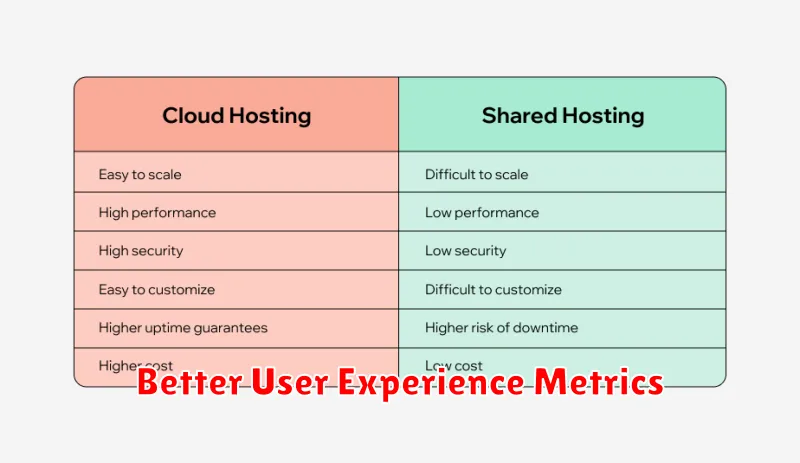
Cloud hosting significantly impacts key user experience metrics. With improved performance and scalability, cloud hosting contributes to a better overall user experience. Reduced latency leads to faster page load times, a crucial factor in user satisfaction.
Decreased bounce rates are another benefit. When pages load quickly, users are more likely to stay engaged and explore the site. This engagement translates to improved conversion rates as users can easily access and interact with content.
Increased uptime ensures website availability, minimizing disruptions to user access. Consistent availability is essential for maintaining user trust and encouraging repeat visits.
