
In today’s fast-paced digital landscape, website performance is paramount. Slow loading times can lead to high bounce rates, lost revenue, and a negative impact on user experience. Leveraging a Content Delivery Network (CDN) in conjunction with cloud hosting offers a powerful solution to optimize website performance and enhance scalability. This article explores the numerous benefits of integrating a CDN with your cloud hosting infrastructure, ultimately leading to a more robust and efficient online presence. Understanding how CDNs and cloud hosting work together is crucial for anyone seeking to improve their website’s speed, reliability, and reach.
By distributing content closer to end-users, CDNs significantly reduce latency and improve content delivery speeds. When paired with the inherent scalability and flexibility of cloud hosting, the result is a highly performant and resilient website capable of handling traffic spikes and ensuring a seamless user experience regardless of geographical location. This synergy between CDN and cloud hosting is particularly beneficial for businesses with a global audience or those experiencing rapid growth. Discover how this powerful combination can elevate your website’s performance and provide a competitive edge in the digital marketplace.
What Is a Content Delivery Network?
A Content Delivery Network (CDN) is a geographically distributed network of servers that work together to accelerate the delivery of online content. These servers store cached copies of your website’s static assets, such as images, videos, and JavaScript files, closer to your users.
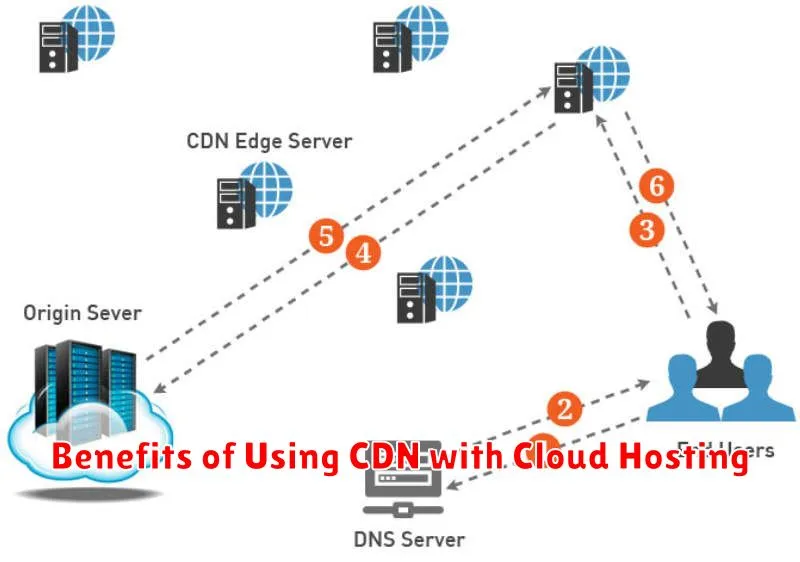
When a user requests content from your website, the CDN redirects the request to the server closest to their location. This reduces latency, meaning faster loading times and a better user experience, particularly for users located far from your origin server.
CDNs also contribute to increased website availability and improved security by absorbing traffic spikes and mitigating distributed denial-of-service (DDoS) attacks.
How CDN Works with Cloud Hosting
A Content Delivery Network (CDN) works in conjunction with cloud hosting to optimize content delivery to end-users. When a user requests content from a website hosted on a cloud server, the CDN intercepts the request.
The CDN then determines the closest server to the user’s location from its network of distributed servers. If the requested content is already cached on that server, the CDN delivers it directly to the user. This reduces latency and improves loading times.
If the content is not cached, the CDN retrieves it from the origin server (the cloud hosting server) and caches it for future requests. This process reduces the load on the origin server, improving its performance and availability.
Boosting Page Load Speed

A primary advantage of using a CDN with cloud hosting is the significant boost it provides to page load speed. CDNs store cached copies of your website’s static content (like images, CSS, and JavaScript files) on servers geographically closer to your users.
When a user requests your website, the CDN serves this content from the nearest server, reducing latency and improving load times. This results in a better user experience, lower bounce rates, and improved search engine rankings, as page load speed is a crucial factor for SEO.
Improving SEO and User Experience
Content Delivery Networks (CDNs) play a crucial role in enhancing both Search Engine Optimization (SEO) and user experience. By caching static content closer to users geographically, CDNs reduce latency. This faster loading time significantly improves user experience, encouraging visitors to stay longer and explore more content.
Reduced bounce rates and increased time on site are positive signals to search engines, ultimately boosting your website’s search ranking. Furthermore, CDNs contribute to improved website availability and reliability, factors that also influence SEO. A consistently available and fast-loading website leads to happier users and higher search engine visibility.
Global Coverage and Low Latency
A primary advantage of using a CDN with cloud hosting is the global coverage it offers. CDNs distribute content across a network of servers located worldwide. This strategic placement minimizes the distance between users and the requested data.
This reduced distance directly translates to lower latency. When a user requests data, the CDN serves it from the closest server, resulting in faster loading times and an improved user experience. This is especially beneficial for businesses with a global audience, ensuring consistent performance regardless of user location.
Redundancy and DDoS Protection
A significant advantage of integrating a CDN with cloud hosting lies in enhanced redundancy. CDNs distribute content across multiple servers geographically. If one server fails, others seamlessly take over, ensuring continuous availability. This minimizes downtime and provides a consistent user experience.
Furthermore, CDNs bolster your defenses against Distributed Denial-of-Service (DDoS) attacks. By absorbing malicious traffic across their distributed network, CDNs prevent your origin server from being overwhelmed. This protection against DDoS attacks safeguards your website or application from disruptions and maintains accessibility for legitimate users.
Reducing Bandwidth Costs
A significant advantage of using a CDN with cloud hosting is the reduction in bandwidth costs. CDNs store cached copies of your website’s content on multiple servers geographically closer to your users.
When a user requests content, the CDN serves it from the nearest server, reducing the distance the data travels and the load on your origin server. This decreases the amount of data transfer required from your cloud hosting provider, directly impacting your bandwidth consumption and associated costs.
By leveraging a CDN, you can optimize bandwidth usage, particularly beneficial for websites with high traffic or large file sizes.
Integration with Popular Hosts
A key advantage of using a CDN with cloud hosting is its seamless integration with popular hosting providers. This simplifies the process of connecting your cloud-based infrastructure to the CDN, reducing setup time and complexity.
Many CDNs offer pre-built integrations and optimized configurations for major cloud platforms like AWS, Google Cloud, and Azure. This compatibility ensures quick deployment and efficient content delivery across different hosting environments.
This simplified integration process translates to faster time-to-market for your applications and websites, allowing you to leverage the benefits of a CDN more quickly and efficiently.
Monitoring CDN Performance
Monitoring CDN performance is crucial for ensuring optimal content delivery and a positive user experience. Tracking key metrics allows you to identify potential issues and optimize your CDN configuration.
Important metrics to monitor include cache hit ratio, which indicates how often content is served from the CDN cache, and latency, which measures the time it takes for content to reach users. Bandwidth consumption is another important metric for understanding data transfer costs and potential bottlenecks.
By actively monitoring these metrics, you can identify areas for improvement, such as optimizing caching strategies or adding additional CDN points of presence. This ensures your CDN continues to provide fast and reliable content delivery.
Choosing a CDN Provider
Selecting the right CDN provider is crucial for maximizing the benefits of a CDN with your cloud hosting. Key factors to consider include performance, cost, features, and support.
Performance metrics such as latency and throughput should be evaluated based on your target audience’s geographical location. Cost structures vary between providers, often involving factors like data transfer and storage. Consider your budget and anticipated usage.
Evaluate the features offered, such as security measures (like DDoS protection), caching options, and integration capabilities with your existing cloud platform. Finally, assess the quality of customer support provided by the vendor. A responsive and knowledgeable support team can be invaluable when troubleshooting issues.
